

The survey: 683 use cases from across the industry
The categories: tinkering, process improvement, workflow automation
Key finding: most are still tinkering
Pushing the envelope case studies: Pensford/LoanBoss
The Top 20 use cases, categorized and detailed
Implications for CRE jobs

We recently surveyed 727 real estate professionals from across the industry to see how they’re using (and not using) AI. 683 of those survey respondents submitted their best use cases, which we categorized and scored.
Some of the adoption findings were surprising:
76% of users are tinkering with AI.
Most people aren’t as far ahead or behind as they think.
Big firm adoption is handcuffed by unstructured data and security.
Claude dominates the tool usage.
Bottom line: Very few real estate professionals are pushing the AI envelope.
Case studies: Pensford/LoanBoss
Here are two examples (from the same founder/CEO) that surfaced in our survey that are pushing the envelope:
Example 1: Quoting interest rate caps
Quick background on Pensford…
Pensford is a rate hedging advisory shop. When a commercial real estate borrower takes on floating-rate debt, the lender almost always requires an interest rate cap, which is essentially an insurance policy that limits how high the borrower’s rate can climb. Pensford helps borrowers price, buy, and manage those caps. JP Conklin started and runs the firm.
Pricing a cap starts with a quote request. Pensford gets more than 900 of them a day, and every one lands as a plain email. Unstructured. No form, no fields, no clean data to hand a machine, which is why nobody had ever automated it. Traditional software would have made the customer fill out a form and hit submit, but who wants to do that? Especially when many clients want a matrix of alternatives. It’s complicated. Not great for a form but perfect for AI.
Pensford pointed AI at the inbox by connecting Outlook, Claude, n8n, and the firm’s proprietary pricing models. The second a request arrives, AI reads the email, routes it to the cap pricing model, pulls the quotes, and drafts the outbound response. Someone on the team reviews and approves each email. This has reportedly saved deal managers 2-3 hours per day. Across the platform, that adds up to 600+ hours a month. JP calls it the single biggest efficiency gain they have ever had.
Example 2: Loan abstraction
“We’ve been working on a proprietary AI abstract tool for nearly two years and for most of that time, the results were mildly disappointing. Then in the last few months, everything started to click into place. Accuracy jumped to north of 95% and time dropped to 4 minutes for the hardest loans (agency loans are under a minute).”
JP Conklin, Founder/CEO, Pensford and LoanBoss
LoanBoss (JP’s other company) puts every loan, prepayment penalty, and lender exposure a borrower holds on one dashboard. But a dashboard is only as good as the data behind it, and that data has to be pulled out of the loan documents.
The LoanBoss team reads a loan document and pulls up to 400 fields out of it by hand. Painstaking, but this is the foundation everything else is built on.
Speed was only half of it. At first they still uploaded one loan at a time. So they built a queue and used n8n to connect it to a shared drive where the docs already lived. Now files flow in, get abstracted, and come out the other side. 100 loans a day.
The payoff: a 100-loan portfolio that used to take 2-3 months to onboard now takes a few days, most of it a human QA-ing every field. A three-month project becomes an impulse buy.
This is a good example of a popular use case that surfaced in our survey: document review and abstraction. As we cover in our courses, our business is an industry defined by transactions; there are four types of transactions, and every transaction is memorialized in a set of documents. The leading edge of AI in real estate is defined by LLMs’ ability to power through real estate documents.
How we scored the use cases
We didn't just ask people how they were using AI. We asked them to describe their best use cases, then graded each one against a rubric and sorted the 683 into three levels:
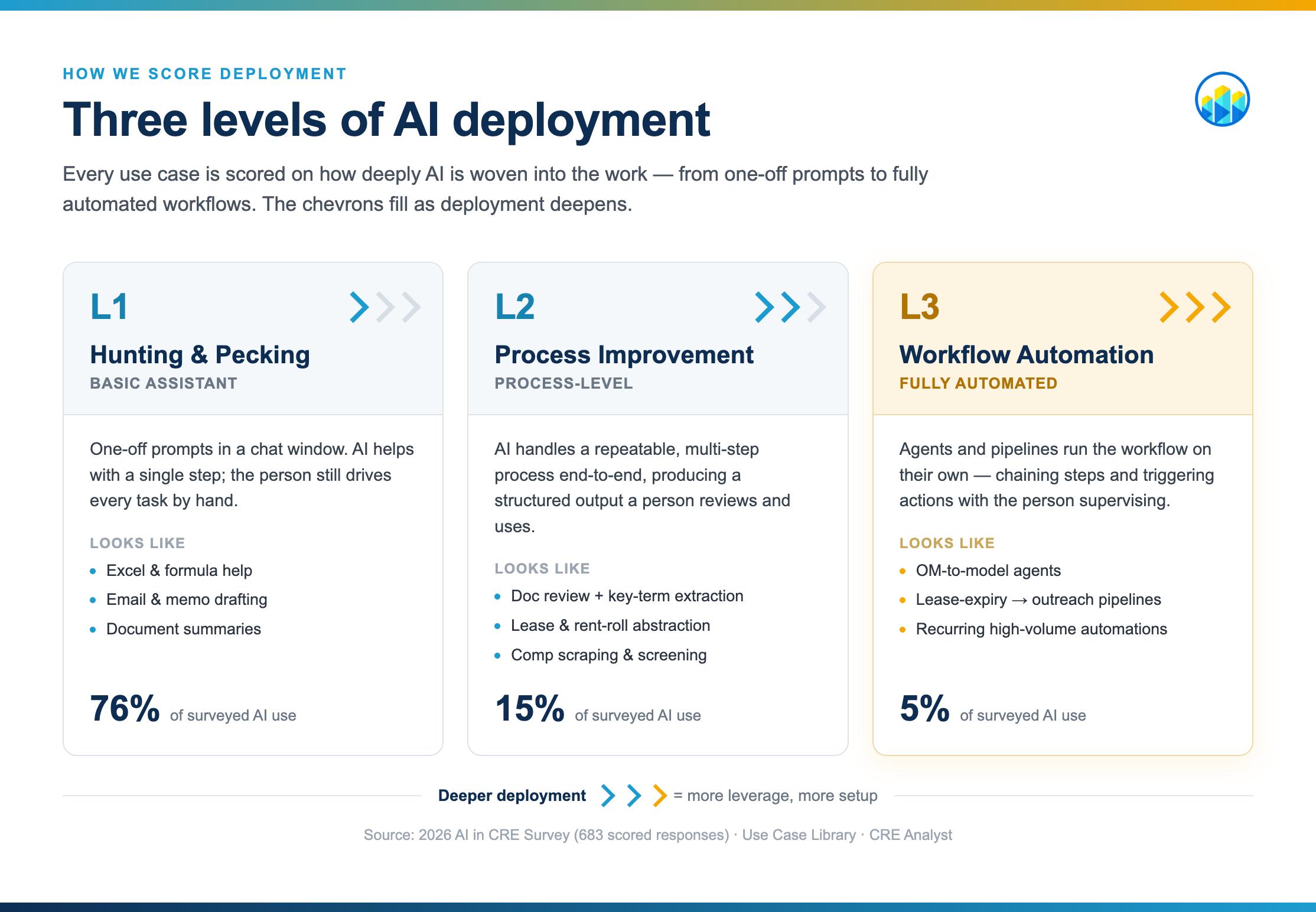
Pensford's quote process is a clean Level 2. It transforms the workflow but keeps a human approving every quote. L3 (fully autonomous) would be the wrong move here, since the bespoke nature of these requests rewards a human in the loop.
Tools vs. systems
Once the data is abstracted, structured, and mapped to the right fields, the loan document itself stops mattering. You don’t make the AI go read the doc and guess. You point it at clean, structured data it can trust. And at that point, the customer can do almost anything they want with it.
Every LoanBoss customer effectively has customizable software. The home page is an AI interaction, a blank canvas. Clients can build their own Skills, including ones LoanBoss would never have thought to build, such as complex what-if scenarios, custom metrics, etc.
JP’s favorite example was a demo with a lender who wanted to track back leverage. LoanBoss doesn’t have a back leverage metric. But it has the plumbing. So on the call, they built a back leverage Skill from scratch. The client described what they wanted, LoanBoss spun it up, and the first pass was already pretty good. Change the advance rate, the outputs update instantly. From there the client tweaks, iterates, and shares it with the team. The old way would have required a 6-9 month software build but the new way is a five-minute exercise the client owns.
That’s the bigger idea. LoanBoss isn’t really selling a dashboard. It’s selling the plumbing: 400 fields cleaned, structured, and mapped, hundreds of millions of calculations a day, all sitting underneath. That makes it less of a tool and more a system you build on.
One of the second-order takeaways that came out of our analysis and follow-ups in our survey was this chart:
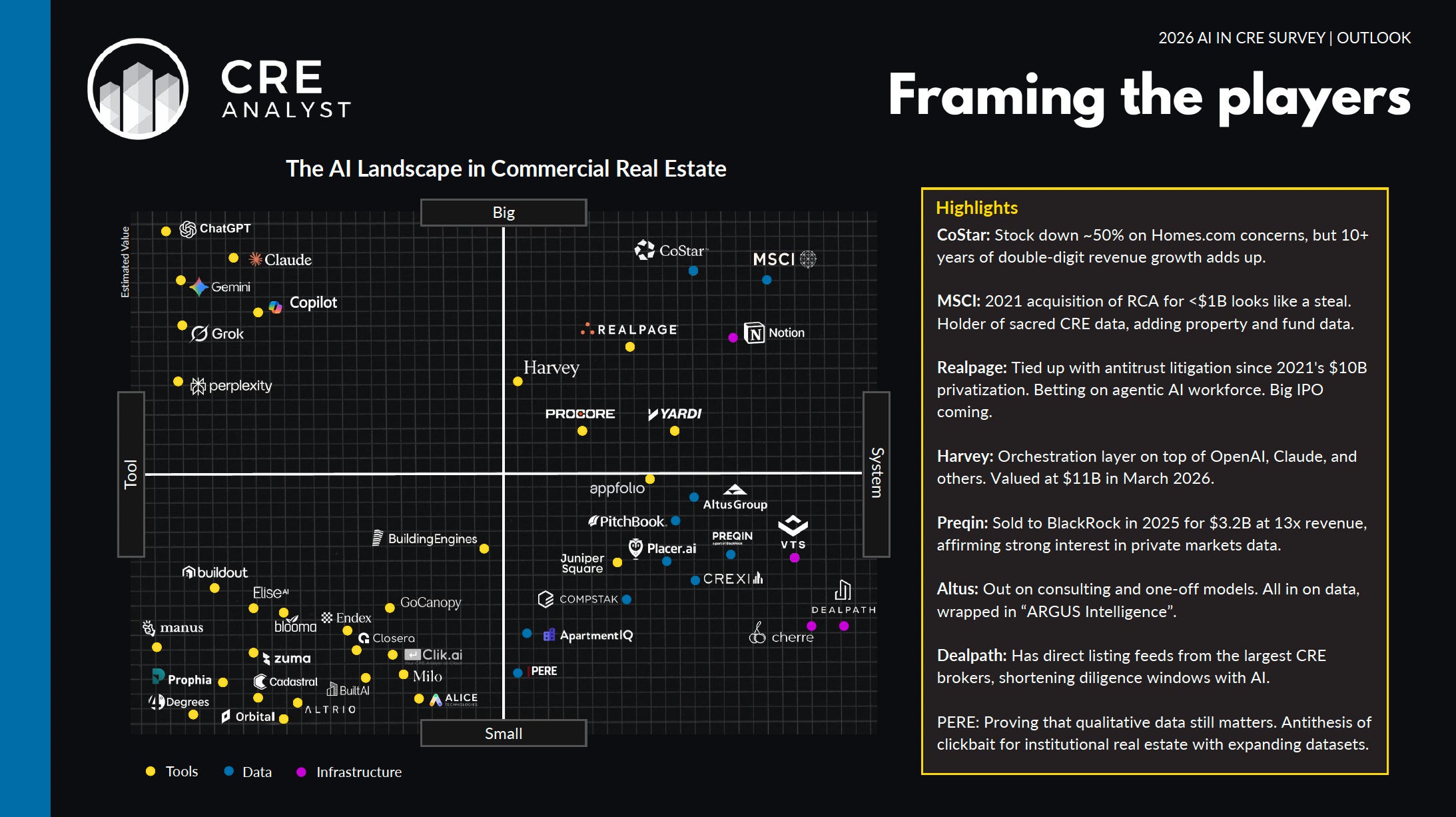
The chart above represents our team’s interpretation of where AI players fit into the field. More than the color of the dots or where they land, we think the movement of firms on this chart and the framework itself are valuable. Quick takeaways: yellow dots are tools, blue represents data providers, and purple represents infrastructure/systems (i.e., the ‘pipes’ that hold and carry data and processes).
LoanBoss would have been a yellow dot (a tool) at risk of being SaaSpocalypsed a year or so ago. But now it’s a blue dot (a data engine) and on the way to becoming a purple dot (an infrastructural system), which promotes growth (pushing it toward the top right).
We aren’t paid to profile Pensford or LoanBoss. Instead, we’re highlighting these applications because they surfaced as some of the best use cases in our survey. But these Level 2-3 applications were relatively rare.
Top AI Use Cases in CRE
Here are the top twenty use cases that surfaced in our survey:
