


The AI conversation in commercial real estate is focused on white-collar work that happens entirely on screens. e.g., software, support, content. In these industries, agentic systems are already taking over workflows, forcing executives to decide which AI platform to bet on. That’s the loud version of the AI story. CRE professionals are reading it like it applies to them, but it mostly doesn’t.
The quieter finding from 727 CRE professionals: most people feel behind but aren’t actually that behind. We rated 600+ AI use cases, and there are very few AI power users. Industry anxiety doesn’t match the data.
Importantly, the AI narrative is being almost entirely defined by people and firms selling AI. For example, Anthropic (developer of Claude) recently highlighted that 90% of business and finance jobs are materially exposed to AI. Our findings suggest something materially more measured.
Why? CRE is structurally less exposed than the loudest commentary suggests. Site presence, high-stakes decisions, relationships, regulated documents, judgment under uncertainty. The work isn’t legible to AI yet, and won’t be without integration work that most firms haven’t started. The handful of firms pulling ahead aren’t doing it on better AI. Everyone has access to the same models. They’re doing it on the unglamorous integration work that comes before AI can do anything useful in CRE, and that work compounds.
To be clear, AI will likely change the world and the real estate industry. But this first-of-its-kind dive into how real estate practitioners are using AI points to a complicated implementation curve with divergent winners and losers.
About the survey:
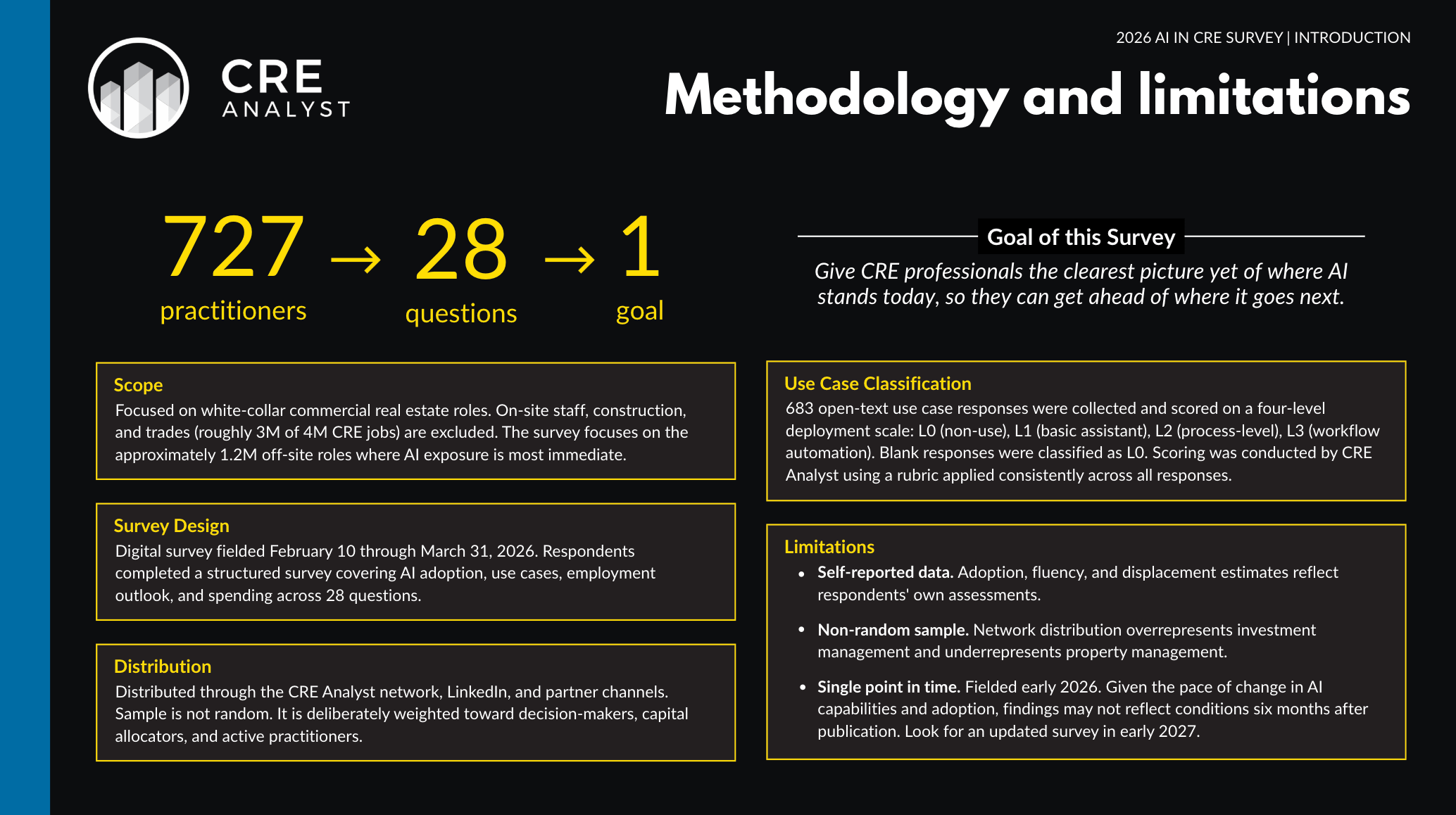
Respondent perspectives:
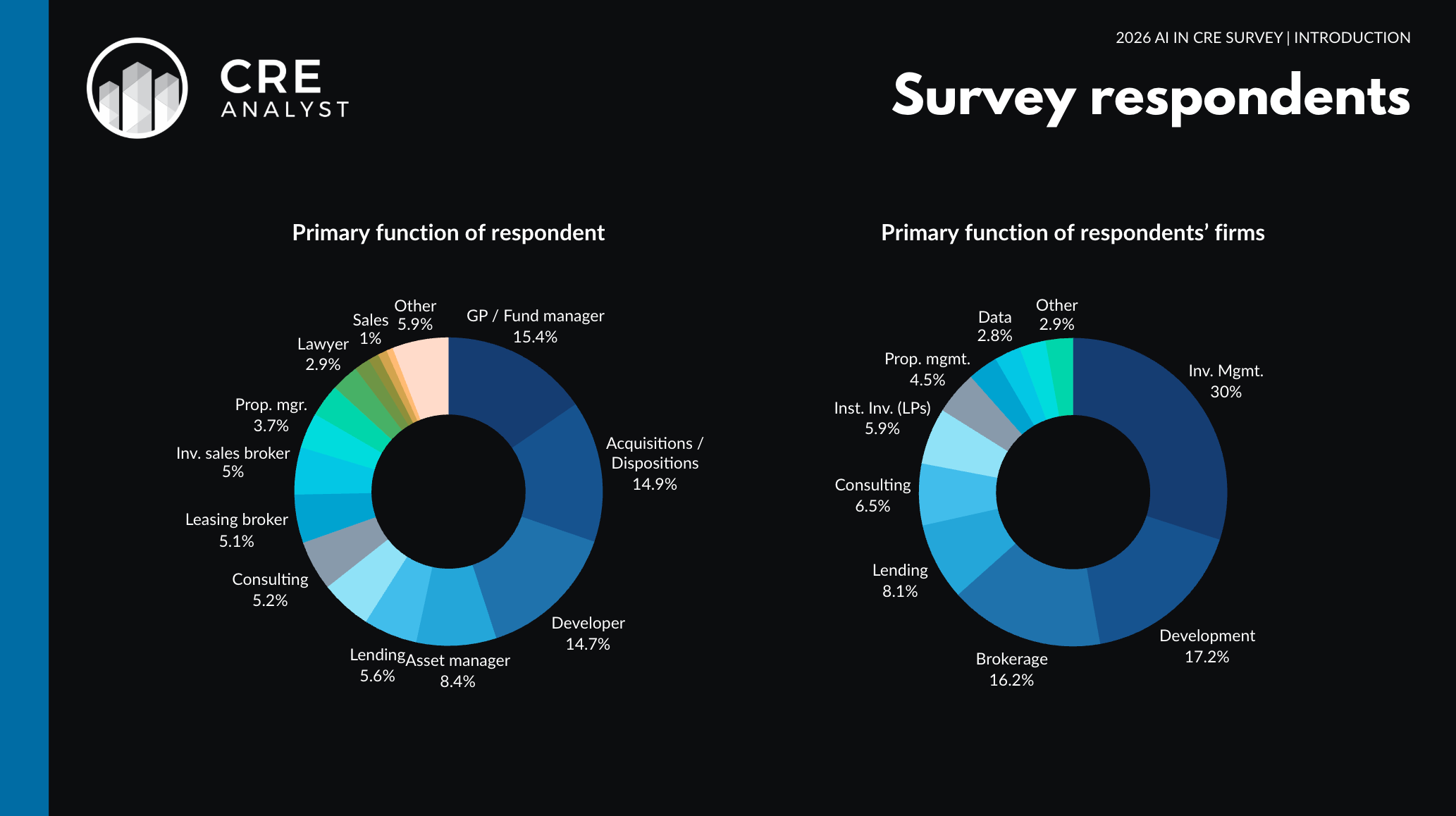
Distributed experience of respondents: 33% of respondents began their careers before 2010, 33% started between 2010 and 2019, and slightly over 33% entered the industry since 2020.
Survey stats:
We surveyed 727 CRE professionals across the industry in early 2026.
87% don't believe AI is overhyped.
Self-reported AI adoption is 5 out of 10, on average.
45% of respondents rate themselves "on par" with peers. 25% rate themselves behind, and 30% rate themselves ahead. Anxiety far exceeds separation.
Fewer than 1% of firms are cutting AI budgets.
“You were just gifted a multi-trillion dollar tool that most of your peers aren’t seriously using.”
— Appraisal, SVP/MD
Our takeaways:
Most CRE professionals feel behind but only a very few are truly pulling away when it comes to leveraging AI.
The AI discourse formula: profitability + fear + anecdote + confidence
CRE is structurally less exposed: site visits, relationships, regulated documents, sacred data behind firewalls.
The leaders are pulling away on integration work, not just on better AI.
“Nothing has really changed meaningfully due to AI yet.”
— Investment management analyst
THE INTEGRATION GAP
Survey stats:
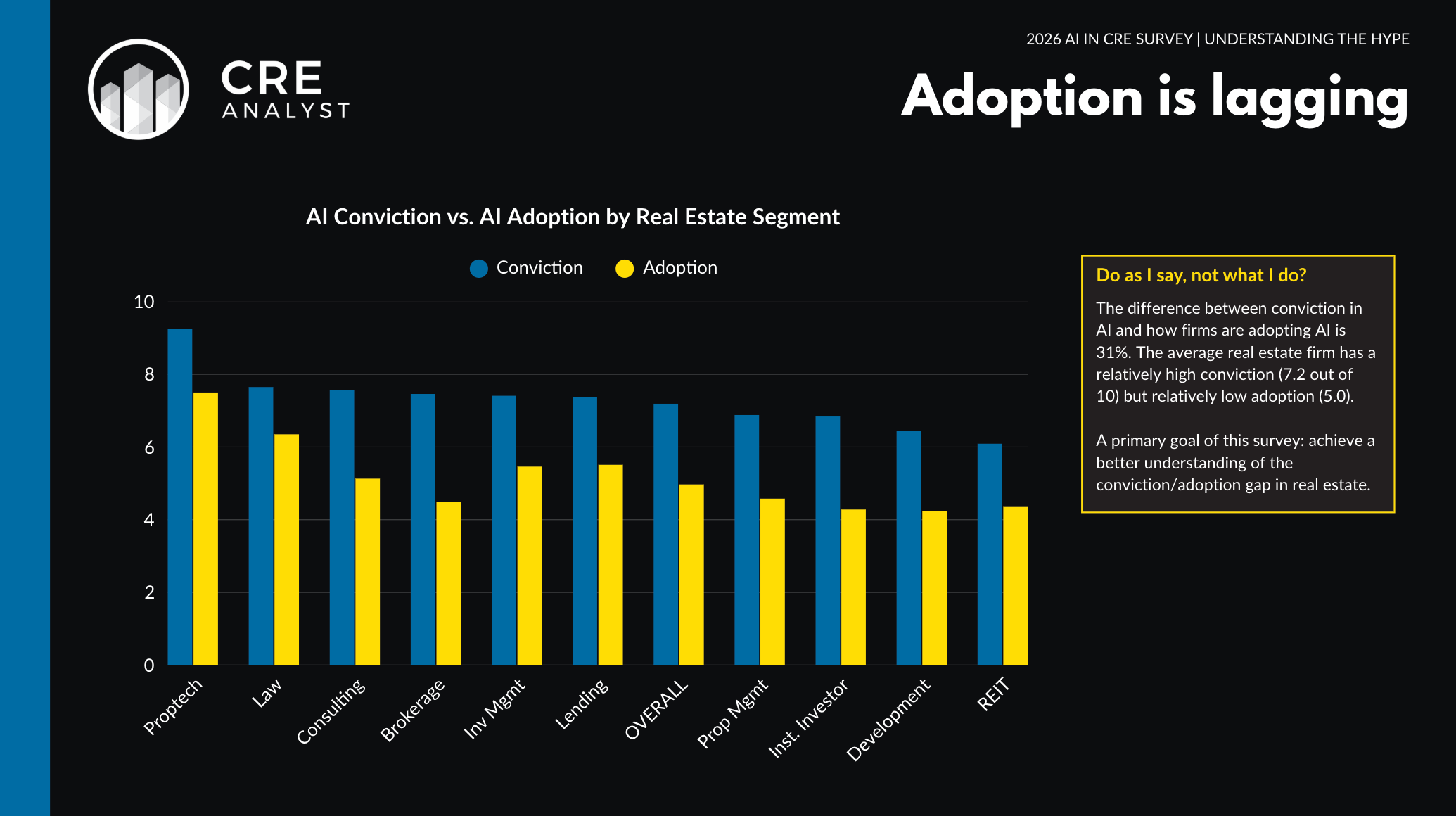
31% gap between conviction (7.2/10) and adoption (5.0/10).
Only 5% of users have reached workflow automation, with another 15% at the process level.
51% rate trust/accuracy as a major barrier (7+ on the 10-point scale).
72% rate at least one operational barrier as major (integration with existing systems, internal data quality, or lack of internal expertise). The plumbing cluster is bigger than the trust cluster (66%).
Attorneys are 50 points more confident in their job security: Market rates legal disruption at 69/100 exposed. Attorneys rate their own exposure at 19/100. Largest perception delta in the survey.
"Locally we utilize and continue to evolve and innovate use cases. Organizationally, we struggle to navigate security and implementation."
— Lender, credit authority, SVP/MD
Our takeaways:
CRE work doesn’t sit in clean APIs. It sits in scanned PDFs, undocumented Excel models, and isolated Argus files and Yardi exports.
A lack of trust is the headline risk, but slop and hallucinations have improved meaningfully, and most large firms have already cleared big LLMs for sanctioned use. Trust seems to be a solvable barrier.
Integration is the real barrier, which could help to explain why small companies in the survey are competing with big ones on AI integration. AI agents can’t plug into old plumbing.
Most AI users in real estate (83%) leverage tools for generic, hunting-and-pecking productivity, which doesn’t require integration.
Integration work compounds. A firm twelve months in has a year behind it. A firm that hasn’t started has that year still in front of it.
Attorneys aren’t outliers. They’re the canary. The 50-point inside-outside disruption gap reflects informed skepticism, not denial.
“Don’t be the dumbass that puts a lease into ChatGPT or any other public LLM.”
— Institutional LP, analyst
HOW CRE PROFESSIONALS ARE ACTUALLY USING AI
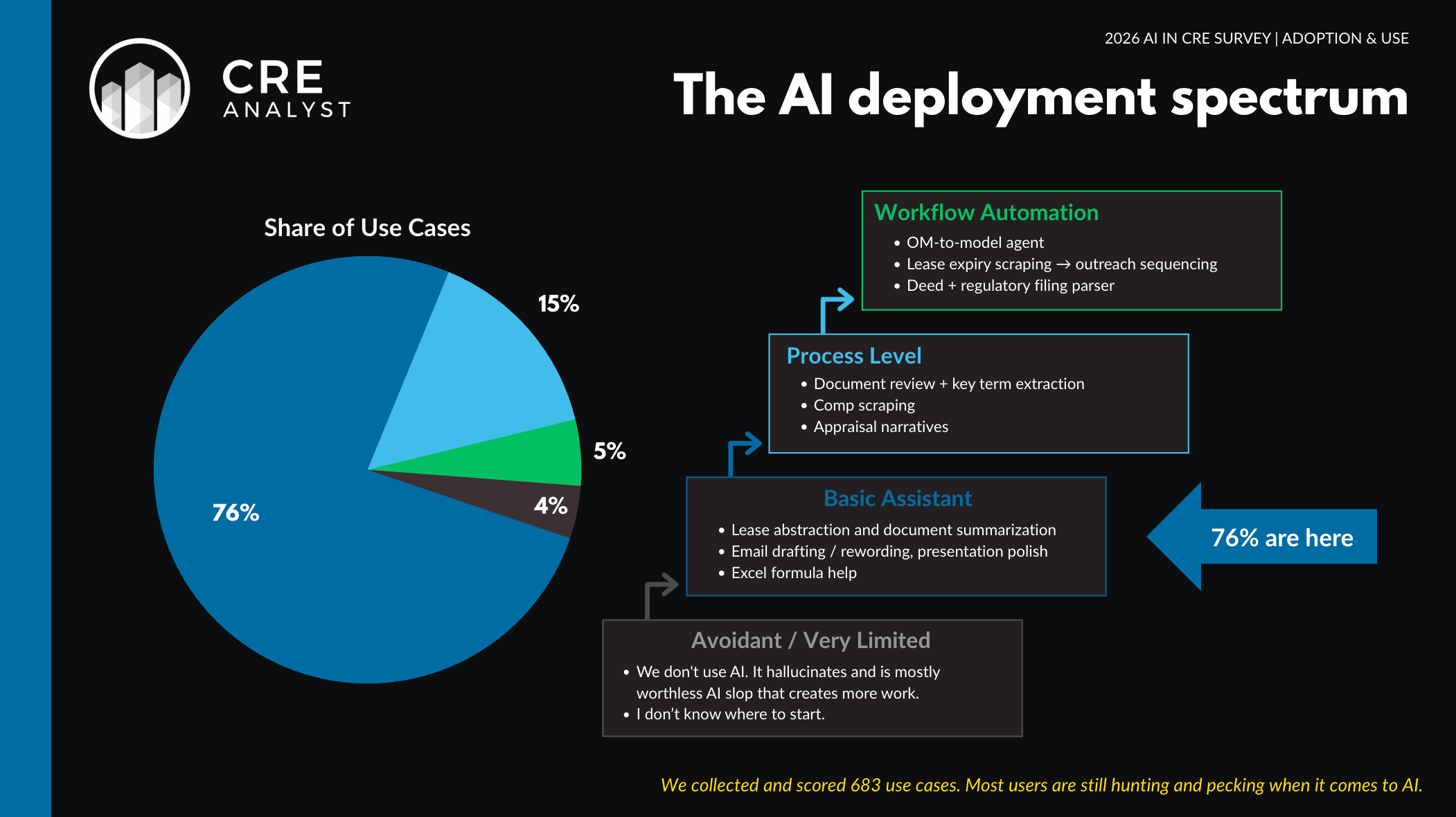
Our survey respondents submitted 683 use cases that we reviewed and categorized into four deployment buckets, ranging from L0 (non-users) to L3 (workflow automation). Most CRE professionals sit in the middle. Roughly two-thirds are using AI for something, but most of that something is generic. Email drafting, document summarization, Excel formula help. Useful but not transformative.
CRE-specific work is rare. When respondents described their best AI use cases in open text, only one in six described something CRE-native. The other five out of six were doing the same kind of work professionals in every industry are doing with AI: writing, research, document abstraction, basic editing. The dispersion in the survey isn’t between AI users and AI non-users. It’s between shallow users and deep users.
Investment management leads on both axes. Lending goes deep into the loan documents. The dividing line across all segments is the same: shallow doesn’t require integration. Deep users built their integrations.
Survey stats:
4% are not using/avoiding AI.
76% are using AI as a basic assistant.
15% are leveraging AI to improve processes on demand.
5% workflow automation
Most common use case categories: research/market analysis (~30%), document abstraction (~29%), writing/drafting (~24%), financial modeling support (~15%)
Investment management leads on both breadth and depth
"It works very well as a research assistant, but due to hallucinations, everything typically needs to be double checked."
— Institutional investor, asset management, SVP/MD
Our takeaways:
The avoiders aren’t ignorant. Some are deliberately staying out because they tested AI and were disappointed.
The dispersion isn’t AI users vs. non-users. It’s shallow users vs. deep users. Shallow doesn’t require integration. The deepest users are leveraging custom-built tools and systems.
“The re-work is more than if we did it without AI."
— Investment manager, GP, C-Suite
If only there were a place you could engage with leaders who are integrating AI into their businesses…

Realcomm 2026 will deliver the most comprehensive and sophisticated conversations on AI for commercial real estate anywhere in the western hemisphere. From case studies and presentations to live demonstrations, the focus is on how the technology is being deployed in real-world operations. Rather than hype or broad generalizations, the program is grounded in execution, featuring industry leaders sharing measurable results, practical insights, and honest challenges.
Register for Realcomm 2026 here. Use promo code RC26CREA1 to get $200 off (expires tomorrow).
POWER USERS
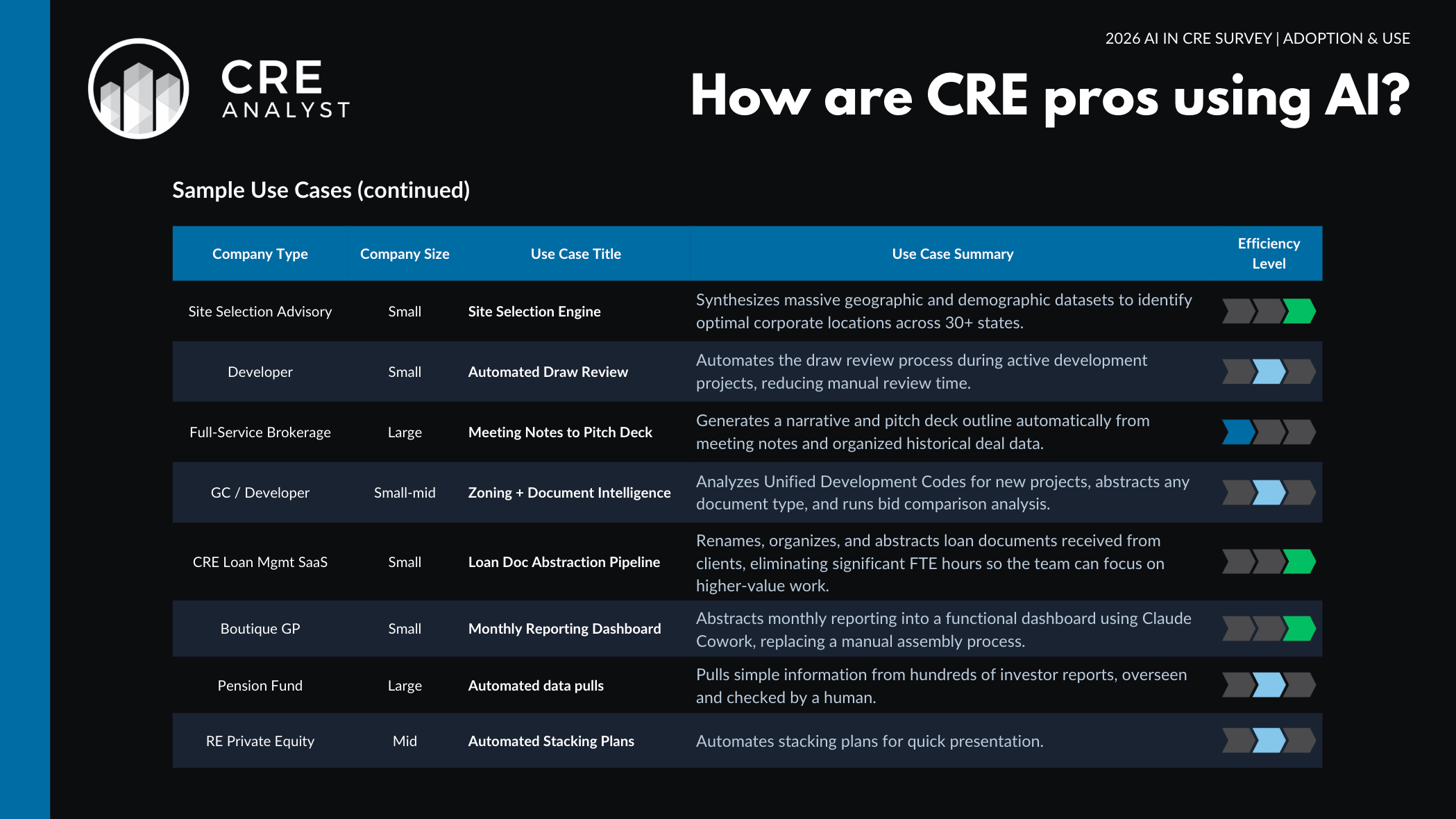
Power users are few, but those who are adding real value aren’t just running pilots. They’re tailoring applications to problems, and the AI is the easy part. The best use cases, to date, aren’t vendor solutions. Every one of them was built by someone inside the firm who decided to do the data plumbing that others couldn’t or wouldn’t do.
The most surprising finding in this cohort: firm size doesn’t predict power usage. A small advisory firm and a $4B credit platform are running at comparable depth. The boutique GP using Claude Cowork for monthly reporting is doing more sophisticated work than the large pension fund running automated data pulls.
The four patterns across these examples, although early in the life of AI, are consistent: build over buy, dependent on proprietary data, leveraging key AI inputs as infrastructure (not as a separate skill), and showing up disproportionately as Claude users.
Sample feedback from respondents on how they are deploying AI:
"We rebuilt the underwriting pipeline as a sequence of agents instead of one model. Dealroom extraction hands off to market intelligence, which hands off to the pro forma, which hands off to the verdict. The platform learns from corrections, so assumptions seed from prior deals and every deal makes the next one smarter. The original goal was speed - spending almost no time on the deals we pass. We achieved that. But the real unlock was insight - being able to instantly leverage every data point we'd ever collected. The hardest part had nothing to do with AI, it was data modeling and workflow design."
— Investor, Acquisitions, VP/Director
“Legal document review — Leases, PSAs, Estoppel Certificates, SNDAs. I also use it heavily for creating customized models and learning new formulas in Excel. On important emails to C-suite clients, I like to polish the syntax with LLMs. During complex negotiations, I use LLMs to role-play different parties in the deal to uncover blind spots our team may have missed.”
— Brokerage, Leasing Broker/Tenant Rep, VP/Director
"Our strongest AI use case has been converting unstructured commercial leases into structured, audit-ready operational data. Instead of manual abstraction taking hours per lease with high variability, we use AI to extract critical clauses (rent schedules, CAM reconciliations, escalation terms, co-tenancy, termination rights) with consistency and speed. The real value isn't just faster abstraction. It's turning static legal documents into searchable, comparable, and analytics-ready datasets that asset managers and lease administrators can actually use."
— Data/Proptech, PropTech Owner, C-Suite
"Using open-source 'OpenClaw' to build AI Agents for any task. These 'employees' operate off persistent memory or a 'brain'. There is my personal 'brain' that deals with emails, text messages and life tasks. The company 'brain' persists for each Agent to make decisions only from that perspective. Guardrails and security are layered in while workflow automation tool (N8N) sits on top giving the 'Orchestrator' (me) control."
— CRE Developer & AI Engineer, C-Suite
“I have created an agent that pulls all relevant info from an OM and pastes it into a secondary assumptions sheet. This sheet is then linked up to the main assumptions sheet to flow through the model. So now, other than custom buildouts, all I have to do is paste in the GPT output, as everything flows through.”
— Institutional investor, Acquisitions, Analyst
Our takeaways:
Most users are generically tinkering with AI on demand. Very few tailored and integrated real estate solutions.
This survey provides unique insight into AI uses across the industry, but they’re all self-reported, which comes with limitations and could mean that there are even fewer power users than reported (few people brag about the busts in their agents).
CUTTING FROM BELOW
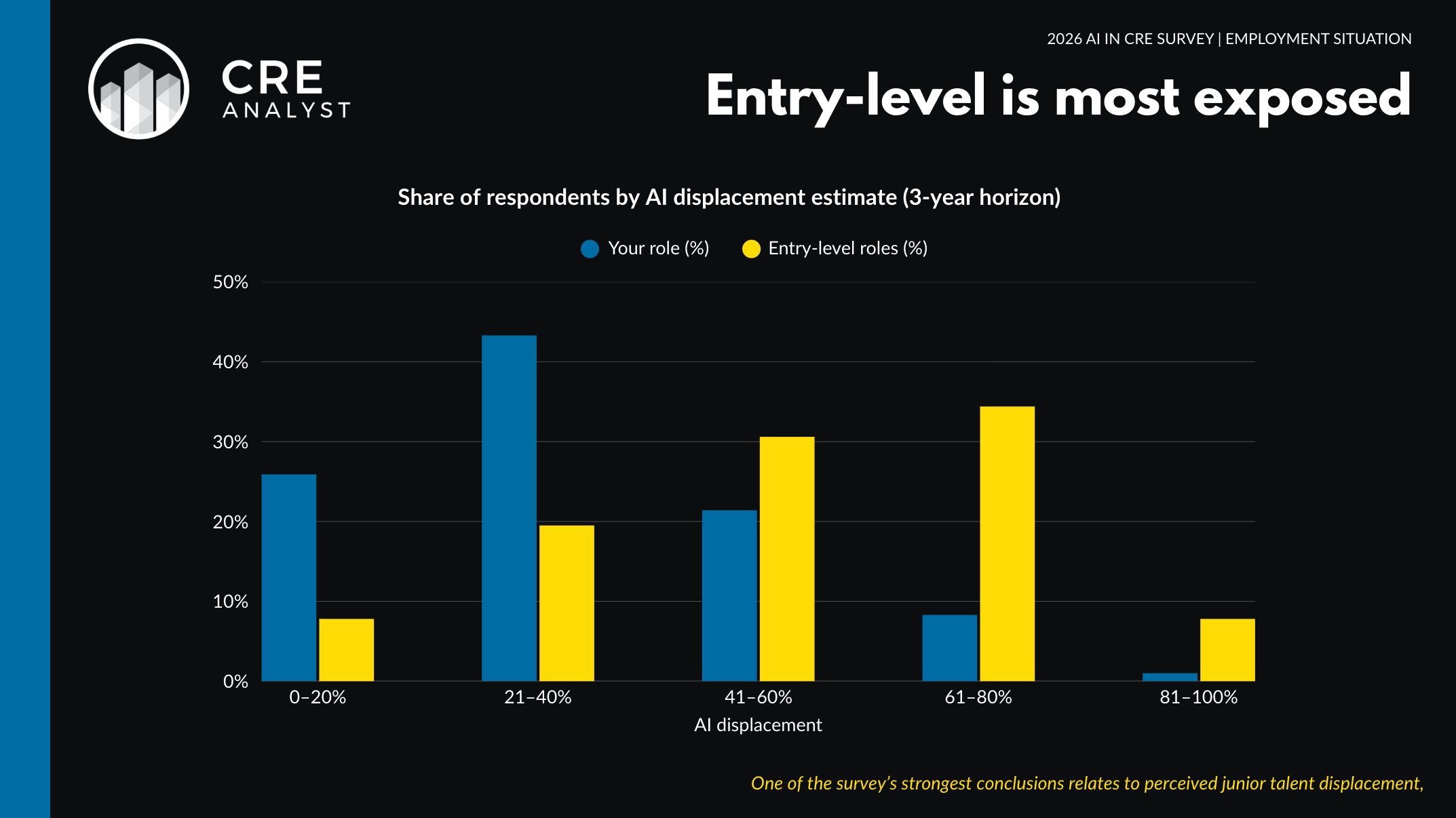
Senior leaders in CRE are restructuring around AI now. The data is unambiguous. Investment managers and GPs are the most aggressive layer in the survey on junior hiring cuts, with one in three already hiring fewer juniors than before COVID. Their junior displacement scores run 10+ points above any other segment. The same senior leaders simultaneously have the highest conviction in not being personally displaced by AI. Cutting from below while feeling personally safe.
The mechanism is straightforward. The juniors who used to abstract leases by hand aren’t being replaced by AI directly. They’re being replaced by mid-levels using AI on top of integration work that took the firm a year to build. The firm doesn’t need the same number of juniors because the senior people are now multiples more productive on the basic tasks juniors used to do. That’s what compounding looks like inside a firm. …or at least that’s what the AI version of this story says.
Another reality: the market’s downshift. Not long ago, there was a gold rush for junior talent where $150k+ was a normal starting comp package for mediocre talent. Hiring accelerated with internships and first-year offers coming in years before start dates. But values and transaction volumes are down 20%, and recent grads are finding a much harder time landing real estate jobs. AI is a convenient excuse for slower hiring and, in many cases, cutbacks.
Survey stats:
36% of investment managers and GPs are hiring fewer juniors than before COVID
Senior leaders have the highest conviction in not being personally displaced
84% of CRE professionals say critical thinking matters more for entry-level hires than 5 years ago
AI fluency is the second most desired trait (per 78% of respondents), above communication (65%)
Financial modeling has fallen out of the top three desired traits
"The speed at which you can build an Excel model is now irrelevant, but the ability to question outputs, understand risk, and understand that humans and markets do not always function rationally will be highly valued."
— Investment manager, GP/Fund Manager, C-Suite
Our takeaways:
Spending increases come with high expectations, and senior leaders are restructuring around AI now. Budget growth doesn’t translate to passive AI adoption. It translates to firms taking action, and the most visible action is at the bottom of the seniority pyramid.
The same senior leaders cutting hardest are the most confident they’re personally safe. GPs and investment managers have the highest junior displacement scores in the survey and the highest conviction in their own job security. Cutting from below while feeling personally safe.
The talent profile firms are hiring for has fundamentally changed. Critical thinking (84%), AI fluency (78%), and communication (65%) have displaced financial modeling (31%) and the credentials that defined CRE careers for thirty years. The skills firms want now are the skills nobody has been training juniors on.
"AI is going to drive individual results polar. Top 3 to 5% performers will be multiple times more productive. Bottom 50% will be active liabilities."
— Developer, Developer principal, VP/Director
THE JUNIOR TRAP
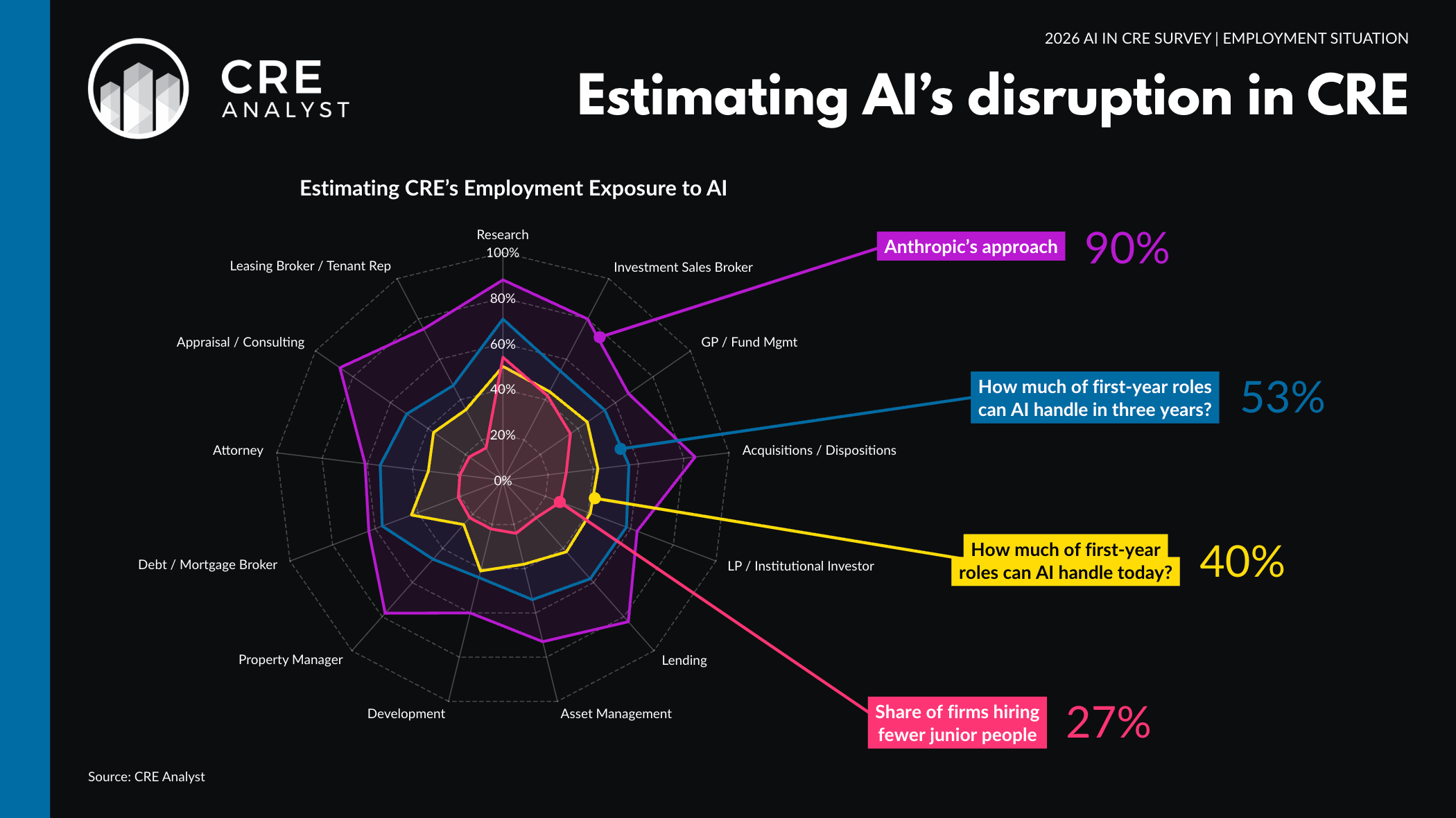
The apparent finding from the survey is straightforward. 66% of CRE professionals expect fewer total jobs in the industry because of AI. Most respondents say AI can already handle 40%+ of an entry-level role today, and 53% within three years. One in three GPs is hiring fewer juniors than before COVID. Critical thinking and AI fluency are the top two skills demanded for entry-level hires. That’s the AI story, and it’s the story most CRE firms will tell when explaining why they hired fewer juniors this year than they did in 2021.
But is the junior hiring downshift really about AI?
CRE hiring has been weak since rates spiked. Deal flow is still well below 2021 peaks. Deal teams that staffed for a transaction market that no longer exists got trimmed. Property and asset management groups that ramped during cheap money are smaller now. The juniors getting laid off, not getting hired, or graduating into a thin pipeline are mostly experiencing a cycle, not a technology shift. AI gives firms a cleaner narrative. “We’re restructuring because of AI” sounds better than “we paid you too much two years ago.” A chunk of what’s being attributed to AI is the cycle wearing an AI mask.
The harder finding for the junior reader is that the diagnosis doesn’t change the prescription. If it’s the market, the door reopens when transaction volume recovers, and the juniors who used the slow years to build critical thinking and AI fluency walk back into a stronger market with a sharper toolkit. If it’s AI, the trajectory is what the survey says: the juniors who built fluency early get the seat. Either way, the answer is the same.
Survey stats:
66% of CRE professionals expect fewer total jobs in the industry because of AI
73% of respondents say AI can handle 41%+ of entry-level roles within 3 years
42% say AI can handle 61%+ of entry-level roles within 3 years
"Careers built on reducing friction (brokerage, analysis, etc.) will be obsolete sometime in the next 10 years. So figure out how to leverage these tools now."
— Lender, credit authority, Analyst
Our takeaways:
The real estate cycle wearing an AI mask: A chunk of what’s being blamed on AI is the cycle. “We restructured because of AI efficiencies” is an easy sell.
Different clocks, same destination: The survey says AI handles 40% of a first-year role today and 53% within three years.
The diagnosis doesn’t change the prescription: Market or AI, the playbook is the same: build critical thinking, develop fundamental expertise, build AI fluency, and don’t wait for your firm to do it for you. The skills the survey says matter most are the skills nobody hands you.
"Thinking rather than processing will be more important than ever."
— Institutional investor, Acquisitions, VP/Director
PROPTECH HUNGER GAMES
The real estate technology space is diverging with commodity tools that wrap a model with a workflow on one side and systems that own proprietary data or workflow infrastructure on the other.
The dividing line in the vendor market is similar to the dividing line we see inside CRE firms: do you own a system, or are you selling a tool? The answer could determine whether you compound or commoditize.
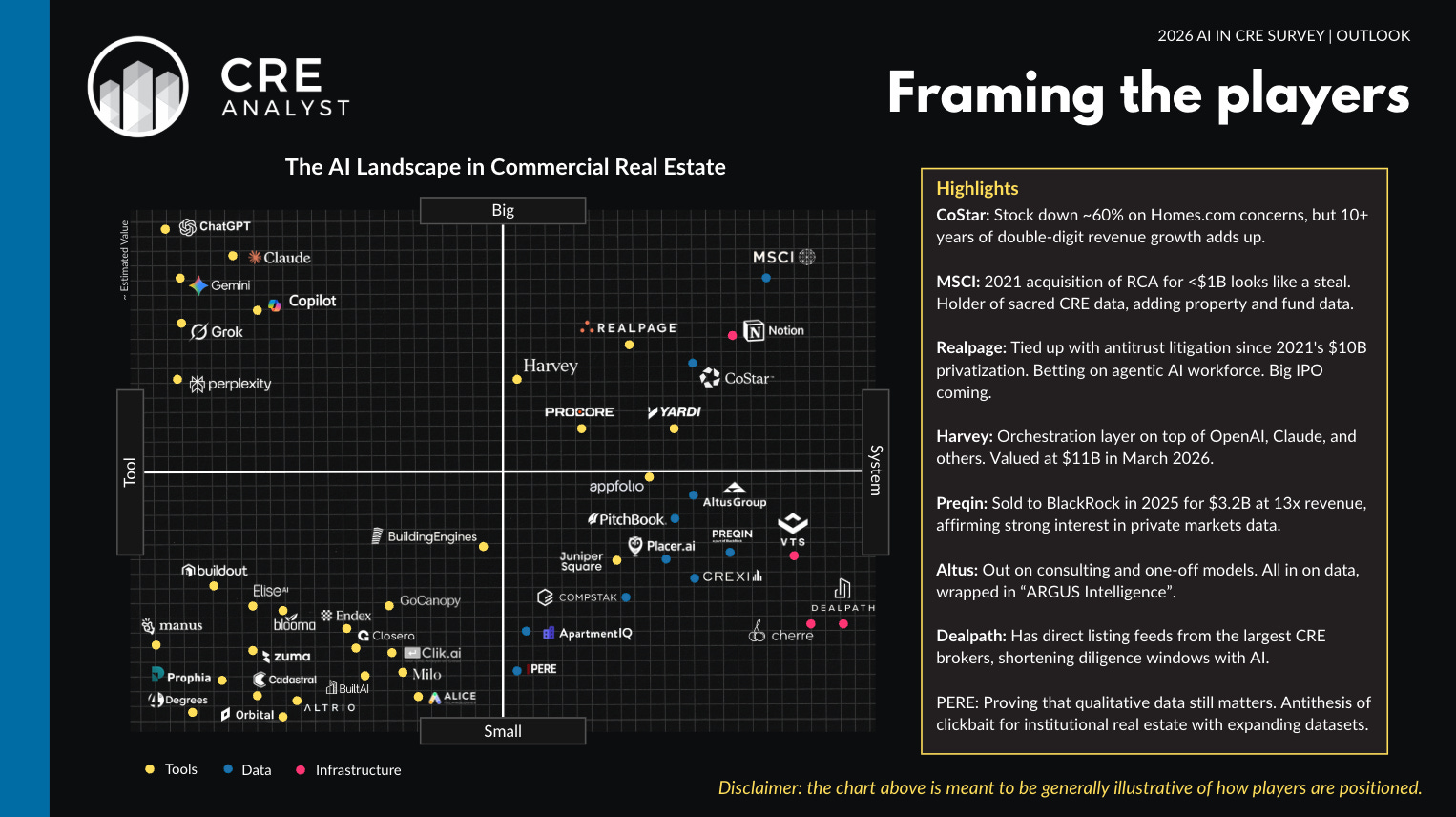
Observations:
CoStar down ~60% despite having one of the most robust real estate datasets.
MSCI’s $1B RCA acquisition (2021) is looking like a steal in retrospect.
Harvey valued at $11B (March 2026); Realpage seeking an agentic path to an IPO; Altus all-in on data via ARGUS Intelligence.
PERE has charted the curation path, focused on industry narrative/news and data.
"Building models and advanced calculations will become commoditized. The value is understanding the why behind inputs."
— Investment manager, LP, Analyst
Our takeaways:
The CRE software market is repricing in real time around who owns systems vs. who sells tools.
Outside of law, tool wrappers are being repriced down, while systems that own proprietary data or workflow are being repriced up.
CoStar has one of the strongest databases in real estate, but its stock price is down by nearly 65%%. Dominance is complicated.
MSCI/RCA, Realpage, and Altus are four different bets on the systems side, in different segments of CRE.
The right side of this chart is where durable value is concentrated.
"Confidentiality is a moat protecting CRE from AI."
— Developer, Developer principal, SVP/MD
POSITIONING FOR THE SHIFTS
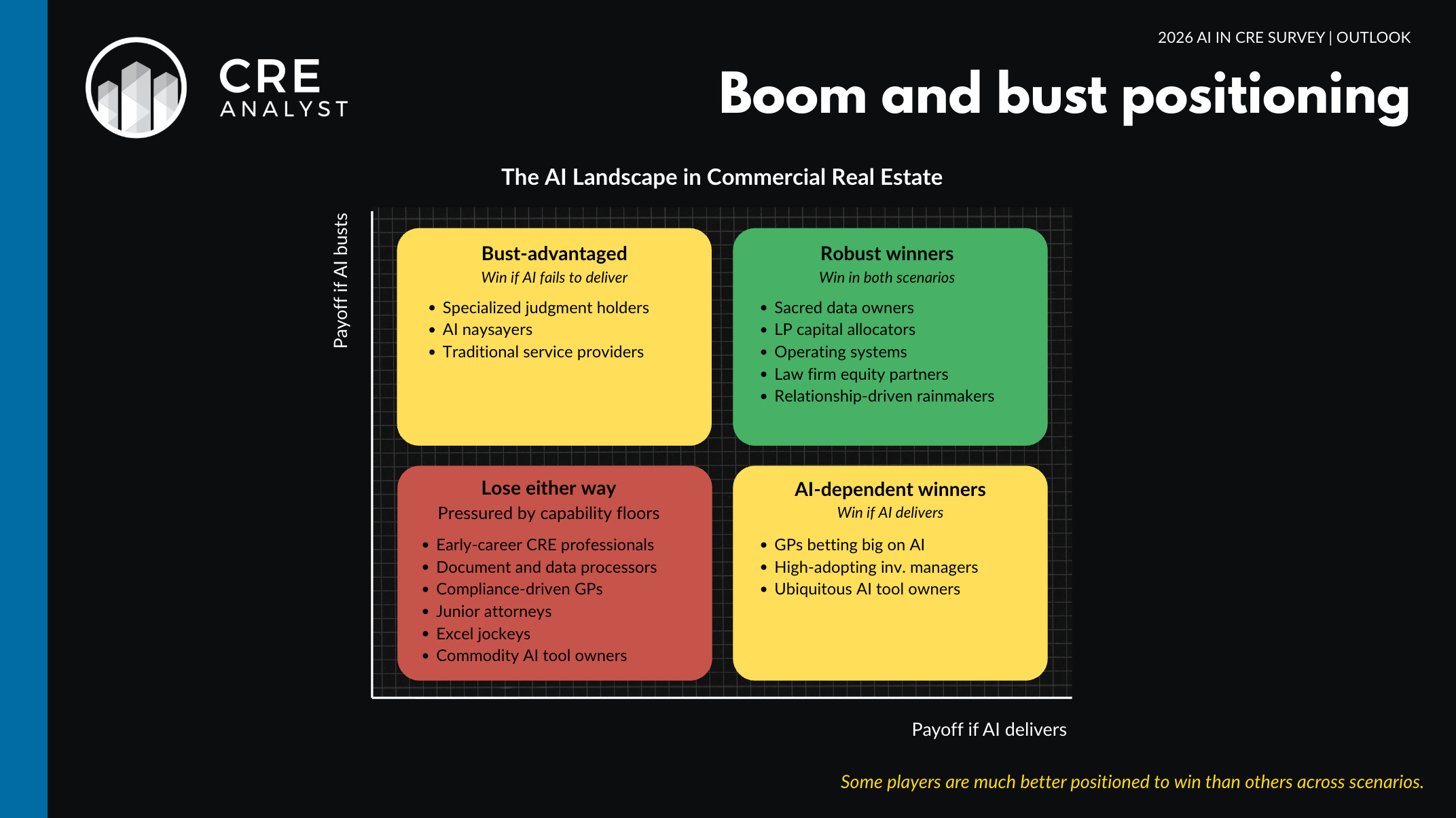
The AI debate in CRE is mostly an argument about which scenario unfolds. Hype believers say workflows are about to be rebuilt around AI, capital is repriced, and firms that don’t move now get left behind. Skeptics say the discourse is overheated, the hallucinations are real, the integration costs are higher than the demos suggest, and most firms will be fine waiting it out. Both arguments are partially right. Neither is a strategy.
The more useful frame may be focusing on positioning across scenarios instead of betting on binary predictions. Some CRE players are robust. They win whether AI delivers on the hype or doesn’t. Some are doubly exposed. They lose either way, pressed by AI’s capability floor on one side and by a soft transaction market on the other. Most firms are somewhere in between, which is its own kind of risk.
For individuals, investing in AI is more about time and focus than capital. But for firms, investing in AI is like borrowing every dime you can to buy a Bugatti. The pictures look amazing. Thrilling test drives. But your million-dollar purchase depreciates rapidly, and you may or may not drive it every day. Navigating the AI puzzle is uniquely challenging for executives.
The four-quadrant map below is a positioning test. The top-right quadrant is the only one where you win regardless of which AI scenario unfolds. Everywhere else is a bet.
"If you're looking for a role that isn't vulnerable to AI disruption, you're wasting your time. Learn how to use, and more importantly, control AI or die."
— Developer, Asset Management, C-Suite
Special thanks
Everything we do at CRE Analyst is team-based, and our AI in CRE survey benefited from the contributions of many different people. Sincerest thanks to everyone who pitched in, including James Ray, Octavio Rivas, and Blake Jones (lead researchers); Gail Wilson, Lexie Howell, Ami Patel, and Austin Roadrick (student research and outreach support); Scott Dunphy, Margaret McKnight, Trey Morsbach, Ryan Severino, Mike Sroka, Rob Cain, Richard Byrd and John Barber (review/sounding boards); Jay Parsons and JP Conklin (outreach).
About CRE Analyst
CRE Analyst exists to provide real estate professionals with best-in-class insights and skills-based real estate training. Each of our training programs originated as a response to specific unmet market needs:
FastTrack is our flagship fundamentals bootcamp with a 90+ NPS and 2,000 alumni; NOTE: our next FastTrack cohort kicks off on May 6, 2026.
Valuation in Argus is a self-paced class focused on the most important skill in real estate, taught within the industry's most-used model.
Career Bridge gives students and early career professionals unique insights into real estate career paths and skill-building activities, leveraging AI.
Tailored corporate training programs have delivered outsized results at leading real estate investment firms.
We regularly publish industry insights leveraging our frameworks and approaches on our insights page, on LinkedIn, and here on Substack (longer form and more actionable).
As a result of this survey’s findings, we are integrating AI case studies into our curriculum, where our participants will leverage Claude, ChatGPT, Claude Code or Codex, and NotebookLM to solve realistic real estate problems. Interested in learning more? Email us at inbound@creanalyst.com.
Fantastic report - detailed research, real insights. Well worth the read!
I like the distinction between what practitioners actually use and what vendors promise. With my proposal assistant, I'm withholding time-saved claims until reviewer effort and correction work are measured too.